
- XRP’s strongest rallies have historically followed breakouts in U.S. small-cap stocks.
- The 2021 XRP cycle may have been interrupted rather than invalidated.
- Token supply plays a critical role in shaping long-term XRP valuation expectations.
Market narratives in crypto often revolve around protocol upgrades, lawsuits, or whale activity. But a growing group of analysts argues that XRP’s most powerful signals may be coming from outside the crypto market entirely. Recent commentary has refocused attention on a recurring intermarket pattern: when U.S. small-cap stocks enter price discovery, XRP has historically followed with its strongest rallies.
At the same time, a separate supply-based analysis is reigniting debate around XRP’s long-term valuation potential, offering fresh perspective on why price expectations vary so widely.
Small-Cap Strength and XRP’s Past Rallies
Crypto commentator Bird recently highlighted a long-term comparison between the Russell 2000 index and XRP’s price action across multiple cycles. The takeaway is simple: periods when small-cap equities break into new highs have repeatedly aligned with XRP’s most aggressive upside moves.
In 2017, the Russell 2000 surged into uncharted territory during a broad risk-on phase. XRP followed shortly after with a rapid climb that ended in a cycle peak. A similar sequence appeared in 2021, when expanding liquidity pushed small-caps higher and XRP rallied strongly—though that move stalled before reaching a clear new high.
According to observers, that cycle was shaped by external pressure rather than market weakness.
Legal Overhang and an Interrupted Cycle
Several analysts point to Ripple’s legal battle with U.S. regulators as a key reason XRP lagged peers in 2021. Exchange delistings and uncertainty weighed on participation, limiting XRP’s ability to fully mirror broader market expansion.
From this perspective, the 2021 rally wasn’t invalid—it was unfinished. That distinction matters now, as the Russell 2000 has once again entered price discovery. Historically, sustained breakouts in small-cap equities have coincided with liquidity rotating into higher-beta assets, including XRP.
Some market watchers believe this sets the stage for another accelerated XRP move if the pattern holds.
The Supply Question: Why XRP Looks So Different From Bitcoin
Alongside intermarket signals, XRP’s token supply remains a central point of debate. With over 60 billion tokens in circulation, XRP operates under very different economics than Bitcoin, whose supply is capped below 21 million.
A recent theoretical exercise explored what XRP’s price would look like if its circulating supply matched Bitcoin’s, while its market capitalization stayed the same. Under those conditions, XRP’s price would rise into four-figure territory, illustrating how scarcity—not popularity alone—drives per-token value.
However, the XRP Ledger was never designed to restrict supply for price appreciation. Its focus remains on liquidity and fast settlement, not artificial scarcity.
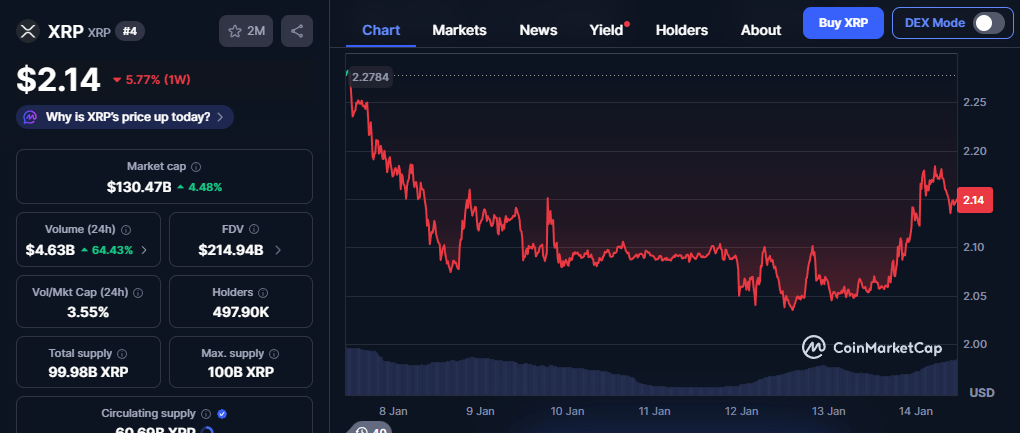
Taken together, the analysis highlights two enduring themes. First, XRP’s largest historical rallies have aligned with broader risk-on phases led by small-cap stocks. Second, supply mechanics play a decisive role in shaping long-term price expectations.
Also Read: Toncoin at a Make-or-Break Level as XRP Quietly Gathers Strength
Whether the current setup delivers another breakout remains uncertain. But for now, XRP sits at the intersection of improving macro signals and renewed discussion about what truly drives crypto valuations.
Disclaimer: The information in this article is for general purposes only and does not constitute financial advice. The author’s views are personal and may not reflect the views of CoinBrief.io. Before making any investment decisions, you should always conduct your own research. CoinBrief.io is not responsible for any financial losses.