- ASTER dropped over 12% despite the launch of automated, fee-backed buybacks.
- The buyback program ties token support directly to protocol revenue.
- Market sentiment remains a decisive factor for smaller DeFi tokens.
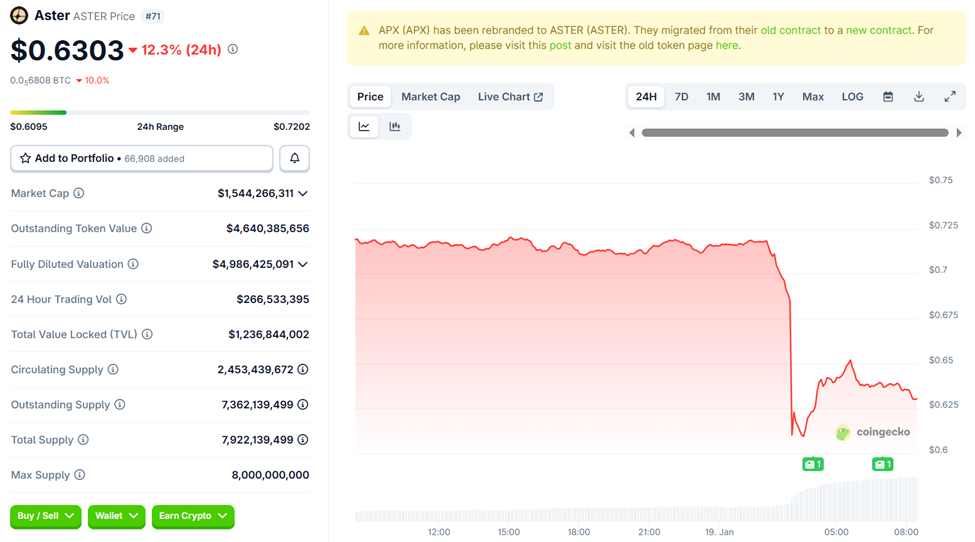
ASTER extended its decline on Monday, falling more than 12% to a fresh all-time low, even as the Aster protocol activated a long-anticipated token buyback program designed to stabilize prices and restore confidence.
The move underscores a familiar tension in crypto markets: long-term tokenomics initiatives colliding with short-term selling pressure. While buybacks are often framed as a supply-reducing support mechanism, ASTER’s latest price action shows that timing and market conditions remain critical.
ASTER Hits Record Low Despite Buyback Launch
Data from CoinGecko shows ASTER trading near $0.63 at the time of writing, after briefly touching lows around $0.61 during the Asian trading session. The drop coincided with the activation of Aster’s Strategic Buyback Reserve, a system that automatically channels a portion of protocol revenue into token repurchases.
According to the team, between 20% and 40% of daily platform fees are now being deployed into targeted buybacks, adjusting dynamically based on market conditions. The purchases are executed on-chain and routed through a dedicated reserve wallet, making the activity transparent and verifiable.
Rather than a discretionary intervention, the protocol describes the mechanism as an automated response aimed at reducing circulating supply during periods of elevated volatility.
Stage 5 Buyback Program Puts Tokenomics to the Test
The latest activation forms part of Aster’s broader Stage 5 Buyback Program, first outlined in late December. The framework was pitched as a fee-backed model designed to create more sustainable token support, rather than relying on one-off treasury actions.
Under the structure, up to 80% of daily platform fees can be allocated to buybacks. This includes a predictable daily component, alongside a flexible reserve designed to react more aggressively during sharp market moves.
In theory, this two-track approach balances consistency with opportunistic execution. In practice, ASTER’s continued slide suggests that buybacks alone may struggle to offset broader market weakness, especially for smaller decentralized exchange tokens facing thin liquidity.
Market Pressure Still Weighs on Smaller DEX Tokens
ASTER’s decline comes amid ongoing pressure across mid- and small-cap DeFi assets, as traders remain cautious and risk appetite stays muted. While similar fee-backed buyback models have recently triggered rallies for other DEX tokens, market response has not been uniform.
In ASTER’s case, the sell-off highlights how bearish sentiment can overwhelm structural support mechanisms in the short term. It also raises questions about whether buybacks are more effective as a long-term stabilizer rather than an immediate price catalyst.
Also Read: $29.7M Wiped Out: XRP Sees Biggest Long Liquidations Since November
Aster’s decision to activate its buyback program at record lows reflects an effort to defend token value through protocol-generated revenue. However, ASTER’s price action shows that even well-structured tokenomics cannot fully counter market-wide uncertainty. Whether sustained fee-backed buybacks can eventually slow or reverse the trend remains a key question for investors watching the protocol’s next moves.
Disclaimer: The information in this article is for general purposes only and does not constitute financial advice. The author’s views are personal and may not reflect the views of CoinBrief.io. Before making any investment decisions, you should always conduct your own research. CoinBrief.io is not responsible for any financial losses.